terça-feira, 21 de outubro de 2014

Nível de poupança americano e as bolhas

Poupança é o dinheiro que não está em circulação, sendo ativos que são facilmente convertidos em moeda circulante. No mercado financeiro, ela serve para financiar empréstimos entre bancos e empresas que necessitem de capital. Então, quanto maior a oferta de capital na poupança, menor é o valor exigido para emprestá-lo, quer dizer a taxa de juros diminui. Descontando outros problemas econômicos, uma economia saudável ao longo prazo possui uma taxa de poupança proporcional ao nível de demanda de crédito.

Dito isso, vamos ao gráfico de taxa de poupança americano:


Nesse gráfico podemos ver que além da queda contínua da poupança desde 1980, vemos também que os dois últimos fundos coincidem com o ano 2000 e 2006.

Mas olha só que interessante. O ano 2000 foi exatamente o pico da bolha das "dot com"
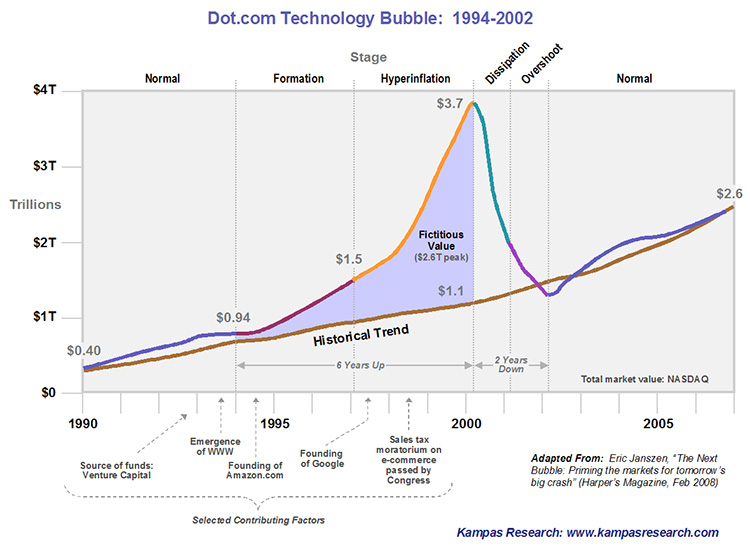

Sendo que também, 2006 foi o ano que os preços das casas começaram a cair


E ainda, segundo a matéria do The Economist:
" Since 2006 firms could auto-enroll their employees: they could automatically put some of their wages in the accounts, unless explicitly told otherwise. This increased participation in these accounts. According to the Wall Street Journal, contributions to 401(k) plans have increased 13% since 2006. "
http://www.economist.com/blogs/freeexchange/2013/04/saving

Como já sabemos, os fundos de pensão (aqueles com o programa do 401k) participaram da farra da securitização dos títulos tipo subprime, colocando lenha na fogueira na inflação desses ativos, e mantendo o ciclo de empréstimos de alto risco. E não só isso, os próprios beneficiários desses ativos pegavam empréstimos colocando as suas poupanças como garantia de pagamento. E além, as pessoas beneficiadas por empréstimo subprime, gente com crédito ruim na praça que passou a conseguir a financiar a casa própria, também começou a utilizar a própria casa não quitada, como garantia de pagamento de empréstimos.

"Across the nation, cash-outs became ubiquitous during the mortgage boom, as skyrocketing house prices made it possible for homeowners, even those with bad credit, to use their home equity like an ATM."
http://www.washingtonpost.com/wp-dyn/content/article/2010/04/03/AR2010040304983.html

E atualmente, segundo a matéria anterior do The Economist:
"Interestingly, the lower levels of liquid saving may explain why there’s been an increase in the number of people taking out loans against their 401(k) plans or paying the penalty to draw on them early"

Vemos então uma população extremamente voltada para o consumo, dilapidando a sua própria poupança pra consumo presente.

Então vem a pergunta. Como uma sociedade toda pode agir de maneira tão irresponsável?

Talvez a resposta esteja na condução econômica do país:


Não é uma relação estrita e direta, já que o FED pode gerar estímulos econômicos sem mexer na poupança, mas segundo o gráfico acima, podemos ver que no geral, a queda da poupança acompanha a alta do PIB e a alta da poupança acompanha a queda do PIB.

Tudo bem que crises provocam a tendência de diminuir o consumo e aumentar a poupança, mas termos a relação inversa para que a economia possa crescer é preocupante.

Pra demonstrar que a coisa pode ser diferente, vamos ver o que acontece na economia chinesa:


A taxa de consumo em relação ao PIB desce, enquanto o investimento e taxa de poupança em relação ao PIB sobe. Relação praticamente inversa ao que vemos nos EUA.


Krugman dando uma mãozinha para wallstreet

A primeira postagem do blog tem que fazer uma abertura digna. Então, nada melhor do que mostrar o que um economista Keynesiano disse no passado.

What is this bailout supposed to do? Will it actually serve the purpose? What should we be doing instead? Let’s talk.
First, a capsule analysis of the crisis.
1. It all starts with the bursting of the housing bubble. This has led to sharply increased rates of default and foreclosure, which has led to large losses on mortgage-backed securities.
2. The losses in MBS, in turn, have left the financial system undercapitalized — doubly so, because levels of leverage that were previously considered acceptable are no longer OK.
3. The financial system, in its efforts to deleverage, is contracting credit, placing everyone who depends on credit under strain.
4. There’s also, to some extent, a vicious circle of deleveraging: as financial firms try to contract their balance sheets, they drive down the prices of assets, further reducing capital and forcing more deleveraging.
So where in this process does the Temporary Asset Relief Plan offer any, well, relief? The answer is that it possibly offers some respite in stage 4: the Treasury steps in to buy assets that the financial system is trying to sell, thereby hopefully mitigating the downward spiral of asset prices.
But the more I think about this, the more skeptical I get about the extent to which it’s a solution. Problems:
(a) Although the problem starts with mortgage-backed securities, the range of assets whose prices are being driven down by deleveraging is much broader than MBS. So this only cuts off, at most, part of the vicious circle.
(b) Anyway, the vicious circle aspect is only part of the larger problem, and arguably not the most important part. Even without panic asset selling, the financial system would be seriously undercapitalized, causing a credit crunch — and this plan does nothing to address that.
Or I should say, the plan does nothing to address the lack of capitalunless the Treasury overpays for assets. And if that’s the real plan, Congress has every right to balk.
So what should be done? Well, let’s think about how, until Paulson hit the panic button, the private sector was supposed to work this out: financial firms were supposed to recapitalize, bringing in outside investors to bulk up their capital base. That is, the private sector was supposed to cut off the problem at stage 2.
It now appears that isn’t happening, and public intervention is needed. But in that case, shouldn’t the public intervention also be at stage 2 — that is, shouldn’t it take the form of public injections of capital, in return for a stake in the upside?
Let’s not be railroaded into accepting an enormously expensive plan that doesn’t seem to address the real problem.
http://krugman.blogs.nytimes.com/2008/09/21/thinking-the-bailout-through/?_php=true&_type=blogs&_r=0

Quer dizer então que os preços dos ativos não devem cair, mesmo que estivessem inflados previamente por uma bolha? Pior, que ainda o Tesouro Nacional tem que estimular a volta dos valores a níveis de bolha, mesmo que isso signifique dilapidar a poupança governamental?

Então tá né?